Showing posts with label Gran Fondo Ellensburg. Show all posts

Friday, June 21, 2019

Gran Fondo Ellensburg 2019: Ride Report

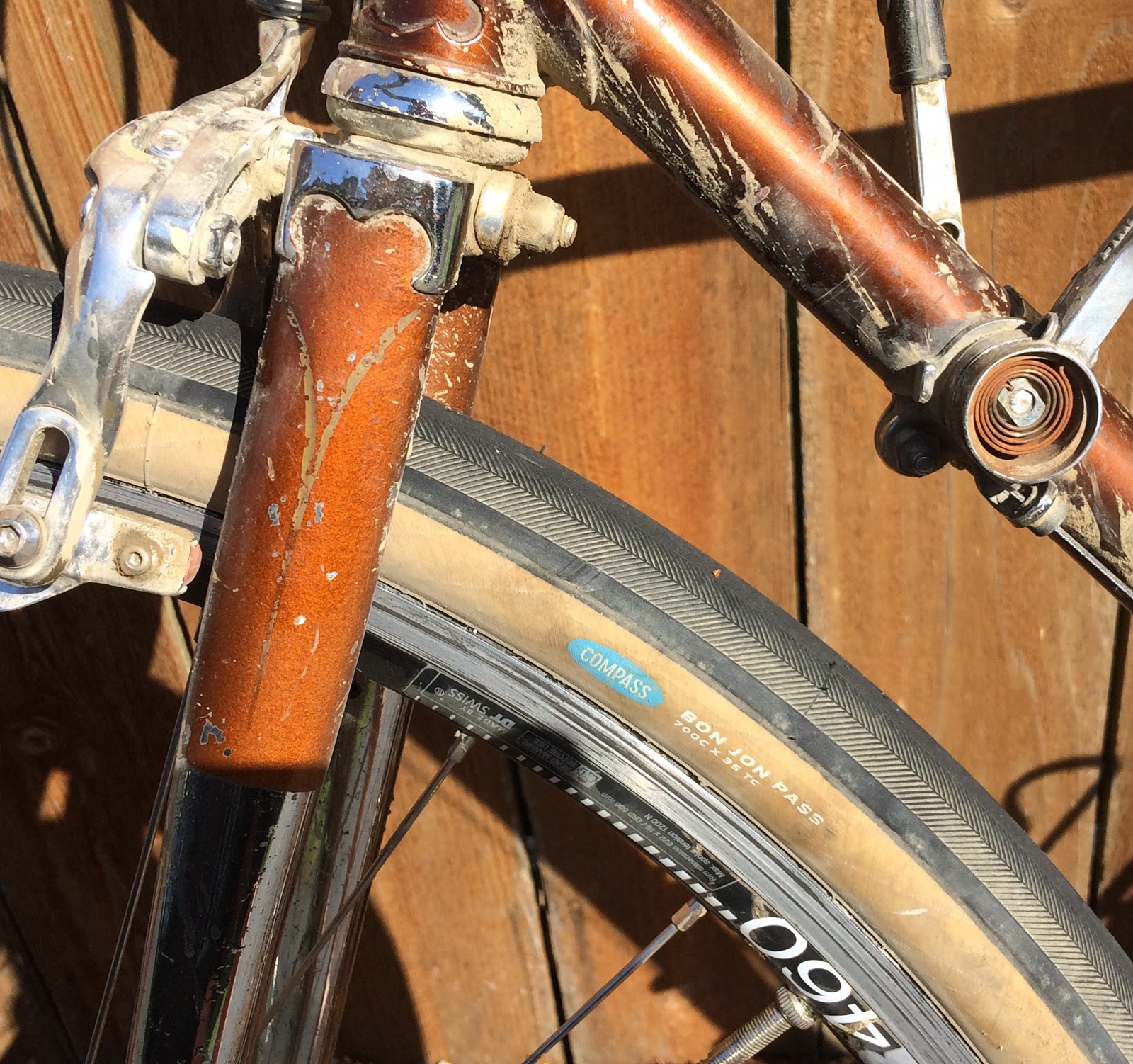
Some gravel dirt and wear and tear on the front - is something missing?
The day went pretty much according to expectations, following the same rhythm as previous rides - a steady and fairly easy beginning with beautiful views of the Yakima river and only the occasional rock; a very hard climb on gravel; some more gravel and beautiful views along a mountain top ridge; several harrowing descents; and a very fast ride back, being pushed by a tremendous tail-wind.

So happy to finish safely and get a badge.

Along with riding with elan and kindness, my goal was to get within 5% of the winner - I didn't quite make it but, all in all, I had a good day! The winning times over the last five years have been quite consistent and, except for last year when I had a couple of flats and a weird kind of a day, my times have been fairly consistent too!

     Winning Time             My Time 
2019 5:29:59 (Ian Tubbs)      5:49:56 (+19:56)(6% off)   8/103
2018 5:25:08 (Derek Parsons)  6:09:29 (+44:20)(14% off) 15/111
2017 5:29:43 (Evan Plews)     5:48:25 (+18:42)(5% off)   5/107
2016 5:26:01 (Steven Mull)    5:42:50 (+16:49)(5% off)  12/124
2015 5:25:31 (Tim Smith)      6:19:28 (+53:47)(17% off) 21/81

I sensed that my training had been quite good and, indeed, my sensations at Gran Fondo Ellensburg on the bike were excellent. My efforts were controlled and solid and I was able for the most part to find gentle, fast and safe lines on the descents. I think my effort on the first climb was fairly consistent from top to bottom and I found that I was passing riders for most of the climb. When I went by the place that I flatted last year quickly and gently I gained (unwarranted) confidence that all would be well this year! The second big climb was solid, I think, but not fantastic. During the middle part of the ride, I suffered some terrible cramps in my hamstrings and calves. They were disabling but got better after I did some climbing while standing and eating some caffeine stuff.  I assume that the cramps occurred because I've done relatively little climbing in training. I felt surprisingly strong over the last 10-15 miles, which I rode with Brian Kohagen, Mark Littrell, and Anthony Dickson. 

The last gravel descent was terrifying. Fortunately, however, I followed a very skillful rider, Brian Kohagen: When he bunny hopped a hole, I bunny hopped, when he swerved left to avoid something, I looked right for a safe line, when he slowed, I slowed, when he got a little too far ahead, I peddled and closed the gap. For most of the descent, Brian and Mark Littrell were 10 to 20 meters ahead of me - and I followed, approaching my limit. 

I was fascinated to learn that Brian was also monitoring his device while descending - and he would brake in plenty of time prior to the corners. I had assumed that he knew the descent well because his speed varied a good deal - but, no, he was relying on his device for signals on braking and cornering.  

The device, the bike, the rider - all working together, somehow. 

How to improve? Given my physiological limits, I'm not sure. Loose a bit more weight. Spend much more training-time on climbing. Keep working at consistency and increase volume, accepting limits of my time. Do hard threshold work paired with long, very, very easy endurance rides. Can I do more weekly minutes of threshold work? Perhaps, but too much of that and I don't seem to be able to recover. And, do very easy recovery rides. Core exercises and stretching have, I believe, been working - I felt fixed to my seat on the climbs and I'm able, I think, to vary by peddling cadence, from around 70rpm to 105rpm, while maintaining control and smoothness. So, I'll keep being consistent at all that. The Fast Talk Podcast has been particularly informative. Dr. Seiler, in particular, says a lot of interesting things!  I suppose its pretty straightforward - peddle better.

Big slash and bubbles on the tire tread.
Got lucky.
The wheels and tires.I was, in short, lucky. My back tire survived, but barely. Somehow I managed to turn about 1/4 of the tread of my beautiful, albeit "somewhat" worn, Bon Jon 35mm tires into bubbles. Yes, bubbles, between the casing and the tread, filled with air but no sealant - just like blisters on one's feet.  Two of the bubbles popped, creating impressive slashes but the casing continued to hold air and sealant.

How did these bubbles occur? I wrote Rene Here Cycles and asked: What can I learn from this? I had three hypotheses: (1) Rider mistake - I locked up the back wheel and skidded; (2) Tire problem - something wrong with the tire; and (3) Worn out tire (see interesting discussion). In their judgement, the bubbles were due to #1 and #3 in combination. I appreciated very much the time they gave over to my question.

I don't understand the physics of the bubbles. How do they occur? Does the friction of braking very rapidly cause the tread to separate from the casing? Why only air and not sealant in the bubbles? I guess, well, because the sealant stays inside the casing but the air escapes the casing. Why would a worn tire contribute to the creation of bubbles? Perhaps because over time with power going into the tire the bond between the tread and casing weakens. Perhaps, the weakened bond together with the friction of rapid de-acceleration, or skidding even on gravel, creates the bubbles. I've never seen bubbles in tires before. It's all very interesting. But, I hope I don't see bubbles again - or feel them while riding!

Did I lock up the back wheel and skid? Oddly, I do not remember locking it up. There was no one singular event as far as I can remember. In fact, I encountered no "known" close calls. But, absorbing events and remembering them seems inhibited when one is highly focussed. Hence, I wouldn't be surprised if I had skidded. I was on and off the brakes repeatedly and aggressively on the descents, at my limit. When at speed and focused - and when trying to be efficient and gentle - braking happens so quickly and unconsciously that I have no idea whether I'm skidding or not. I think not or, if I am, for very short periods of time, but perhaps those short periods of time, if they do occur, add up.

Anyway, last year I was unlucky with my slashed side wall; this year I was lucky to not get a flat (while, for example, riding fast to the finish). That's how things go I suppose. In professional cycling, riders speak of "luck" all of the time, which has always fascinated me. There must be some psychological advantage to appealing to luck - what might it be?

So, all in all, a great bicycle outing in a beautiful landscape. I'm so lucky to be able to ride a bicycle and experience the sensations of riding hard - peddling smoothly; finding gentle and safe lines; shifting cleanly; and chasing that sensation of focus and effortlessness.

Thanks to Vicious Cycle for a great event. Only about 14 weeks until Gran Fondo Winthrop!

I hope I don't see these bubbles again.


Monday, June 3, 2019

Gran Fondo Ellensburg 2019: Getting Ready

This will be my fifth Gran Fondo Ellensburg, a half decade of rides in the beautiful landscape, east of the Cascades, by Vicious Cycle. Still having fun on my 50-year old frame - a 1969 or 1970 Raleigh Super Course. 

Will the ride follow the rhythm of past years (see 2018, 2017, 2016, 2015)? Or, will some fast riders blow things up at mile 10? I hope not. It's fun to draft in a big group for 25 miles or so. 


The ride, 90 miles, 7,000 feet of climbing, 36 miles a gravel. (From Vicious Cycle.).

I'm looking forward to no lost bottles, no flats, no broken rims, no falls - and a nice day out in the beautiful landscape, riding hard. 

Can I get to within 5% of the winning time? I think I've made it to a good level of fitness and if I have a good day - including no flats - it might be possible. But, when out there in the sun and wind, roads and gravel, who knows. About two weeks to go. 


The training has been good - with several very long, hard rides and good consistency. I've been exploring different three-day patterns of training, trying for aerobic adaptions. I don't think I have any Type IIB muscle fibers remaining. With lots of threshold intervals and comparatively long efforts in Zone-3 of a five zone heart rate model, my Type IIB fibers (fast twitch glycolytic), not that have very many of those, have been converted to Type IIA (fast twitch oxidative). 

Unless I'm particularly motivated by, for example, Brig's back wheel, I don't think I can get into Zone 5 anymore. Ha!

With Gran Fondo Ellensburg on week 24, I get two easy recovery-type weeks. This week I'll do one hard interval workout ( 4 x [16 min. HARD + 2 min recovery]) one 3 hour ride and some ridiculously easy recovery-type rides. I'll try to sleep a lot and not eat much and do about 8 hours total. Next week, I'll do several very easy rides and a couple of short, very hard efforts, for about 4 hours prior to GFE. And that should do it. 

Hopefully, somehow I'll meet up with Brig Seidl and Frank Colich after the big descent and we can ride hard to the finish with a big wind blowing us along. 

But, who knows - the main thing is to focus and be alive to all that the day holds. 

I'll try to ride hard, with elan and kindness. 


My Wheels
As regular readers - ha: I don't have any! - know, setting up my tubeless tires (René Herse Bon Jon Pass 35mm) on my rims (DT Swiss R460) has been an ongoing, challenging, and a generally awful pain-in-the-ass process. Here's an account from 2017.


Long story, short: Those fast Bon Jon tires are installed tubeless. 

Jan Heine demonstrates how to do it. His knowledge for materials and his skill is, I think, impressive, actually to my eye utterly extraordinary. 

I've been practicing and trying to learn over the last three years with the same tires, same rims, and same tools.Yet, my skills do not seem to be developing. I'm still incompetent. 

I bought two new Bon Jon 35min tires - planning to install them on rims that worked well last year.  In their tidy packages these supple tires look beautiful. When I look at the tires, lying folded and flat, I'm full of optimism - I'll get them on the rims and they'll be fast. This will be easy, nothing will go wrong.

But, what the hell: 

Tire #1 - It took 90 minutes to get the new tire on the front rim. I tried to blow up the tire with a tube to set the tire bead into the rim shelf but upon deflating the tube the tire separated from the rim. So, that didn't work. So, I went back to the tire and a really loud air compressor and I blah, blah, blah, bah. And more, blah, blah, blah. Finally, I got the tire inflated and dumped 2 ounces of sealant into the tire but then when I tried to inflate the tire with all the nice orange sealant inside it just wouldn't inflate. What! Then, as I was trying to inflate the tire, orange bubbles of sealant escaped and soon enough there was a flood of sealant coming out of the tire. What a mess: Sealant and soapy water all over the garage and all over me and my pants. Fortunately, I had enough sense to not wear good shoes. I tried again and got it to work but without sufficient sealant so I worked on getting two full ounces into the tire the next day. Finally, it worked and I blew the tires up to 50 psi; then, the next day the tire was 20 psi. But, after pumping it up to 50 psi again it stayed there. Yah

Tire #2 - I tried for 60 minutes on the back tire. No damn luck. I figured something must be wrong with the tape job or the valve. Hence, I tried an old Bon Jon tire that was not too worn. And, I got it to inflate immediately; yes, on the first try. What the hell! So, I went with the older tire. It should be okay, I hope. All my fiddling and messing around just did not work with the new tire. I lack knowledge of my materials and tools and I lack some kind of skill. But, where exactly do my gaps exist. I have no idea. 

So there you go. Yes, indeed, Brig, you are correct: I was screaming to myself in anguish, not about my Raleigh headset, but about these wonderful tires. (Nice blog post. I wish I was out there with you on GFL but I needed to travel.)


Anyway, I took the bike and my wheels out for a long Saturday ride and they worked beautifully. Fast on the road and fast on nice gravel. 

For Gran Fondo Ellensburg, I'll put 45 psi into them and hope they work. That's too much air pressure when going up (the bike will be bumping off the gravel); not enough air pressure when going down (at high speed, if I don't find good, gentle lines, I risk ripping the side walls or banging the rim into the ground); and about right on the road. See this very interesting blog post by Jan Heine, and this one - well, actually, read the whole blog: well-written; beautiful photographs; great stories; inspiring in an intense sort of way. 

Anyway, I've taken off the fenders, cleaned up the bike, put on some new brake pads, changed the gear cables, and put on a new chain. That should do it. Ready to go. 

I hope nothing breaks. And, Brig, I do hope that I have sufficient grease in my headset since I've not checked for a while. 

Being Alive
On the Centennial Trail, green as green can be in oh so many patterns, I saw two bald eagles quietly observing a lake (June 2, 2019). What were they thinking about? How did the warm sun feel? Some important questions to consider while being alive to the landscape and riding through the sun and shade.


Monday, June 13, 2016

Gran Fondo Ellensburg 2016, Part II

This year's Vicious Cycle Gran Fondo Ellensburg was terrific. Just like last year! Clear skies. Excellent temperatures. Not much wind. By elegant course design, the rhythm of the ride is beautiful. Great organization. And, the end-of-the-day vegetarian burritos and chocolate milk were very satisfying. It was great to be among so many fit and skillful riders and to have an opportunity to focus and ride hard. 

The Raleigh Super Course - After Gran Fondo Ellensburg 2016 
Leaving a 4:50 AM, after a bowl of cold oatmeal, yogurt, a banana, peanut butter & honey toast, and coffee, the drive from Bothell to Ellensburg in the old green Saturn was relaxing. West of Snoqualmie Pass, I encountered some mist and clouds, and then it became sunny just beyond Keechelus Lake. 

The landscape in the Kittitas Valley and the view from the Indian John Hill overlooking the Yakami River was stunning - brown, dry, but also seemingly green and verdant, mountains with snow, and the 
Yakami river. How is it that landscapes can be so psychologically impactful? 

My thoughts turn to why is this hill called "Indian John?" And, how did this landscape shape human experience three-hundred years ago and how did human beings use and change the landscape? Today, irrigation canals seem to defy gravity and criss-cross the landscape. In 25-50 years will water be flowing in these canals? 


I'm grateful to be able to visit and experience a little of this landscape on my bike. 


Gran Fondo Ellensburg Profile (see course map).
My memory for the ride is foggy, mostly, I think, because I was in focus mode. The rhythm of the ride was precisely like last year (see previous post). For the first 30 miles I stayed in the group, trying not to take any wind and trying to be safe and polite. Then, came the big hill (about 6 miles at an average of about 8.5%). I rode at my limit, if a little too hard at the beginning. After the big climb, riding along the ridge was utterly beautiful, with lovely views of the Cascades.

Working the Super Course on the big hill in a 34x32T. From Vicious Cycle on Facebook.
I recovered quite well on the way down. At the bottom of the first major downhill - just before the climb up to the gate - the road veers left and there is a bit of a creek bed among some trees. Like last year, I almost ate it in one of the two huge potholes that I saw. I barely dodged the first pothole and somehow jumped the second. For next year, I must remember to go slower on this part of the ride. 

The downhill to the second gate was all good (around mile 46 I think). The tires were good and I was able to control the bicycle quite well. 


Then, 5-10 minutes later, bad luck struck. I was going fast on fairly smooth gravel but unfortunately I hit something big - probably a rock - and my front tubeless tire started to hiss madly. Not a welcomed sound. I kept riding. After 100 meters, the tire got to the point where there wasn't much air. I could no longer corner safely. So, I stopped pulled out the valve stem and put in a tube. As I was doing so, six or seven riders went by. I appreciated when some of them asked if I was okay. 

This unfortunate flat tire is a bit mysterious. I'll have more to say about it in a later post because I think I learned something new. 

I got going again and tried to get back into a rhythm. The washboard and corners to aid station #2 were difficult, as expected, but I negotiated these downhills safely. My chain fell off at least three times but I was able to flip it back into place. I suppose this is one of the advantages of friction shifters! Adam VanDyke flew by me on one of these corners and I marveled at his fast and secure line in and out of the corner. 
I filled two bottles and started up hill #2. I was able to ride the climb - loose gravel and all - strongly and took the long twisty downhill conservatively, passing David Delfs at perhaps 1/3 of the way down. 

Once on the pavement I felt good and I tried to find a hard but doable pace. With perhaps 18 miles to go, David Delfs and Frank Colich came up to me. Frank got us organized, and we worked well together, taking 30 second turns, until the finish. Like last year, the wind was generally behind us and from time to time I needed the 48x12T (my hardest gear). Just like Leavenworth, Frank out-sprinted me at the finish! 


I really appreciated being with Frank and David for the final stretch. It was extremely satisfying to ride hard and efficiently together with such strong and skillful riders. (Frank was one of the riders that had passed me earlier when I was fixing my flat. Unfortunately, later in the ride, somewhere after my flat, he was slowed by a fall and had a nasty-looking cut to his arm.) 


I finished in 5:42:50 about 5% behind the winner, Stephen Mull, who came in with a time of 5:26:01. Here are the Results. How much time did I lose with the flat tire? It is hard to know.


So, all goals met for Gran Fondo Ellensburg. Except for the flat tire, the Super Course did well. I had decent gearing on the climbs. The 34x32T was great, although the jump from 34x25T to 34x32T was a bit much at times. I would have liked to have had a 34x28 too! I had good traction on the climbs, good feelings on the downhills and on the corners, and I think I was fairly efficient on the pavement. I conclude that the Trigger 33 mm tires at 40 psi front and 45 psi back were probably pretty good overall choices. I was able to ride the first climb hard, and I was able to ride the second climb and the last 30 miles hard. And, I think I managed my limits on the downhills well enough. 


Most of all, I'm extremely grateful for the opportunity to participate in this ride; to ride with people like David, Frank, Adam, and Jonathan; to be outside on beautiful terrain; to feel and hear the air rushing against me; and to be alive. 

Gran Fondo Winthrop is in 14 weeks and I'm looking forward to returning to the beautiful Methow valley.


Front Wheel. Notice that the tubeless tire and rim are covered in sealant and dirt. After a fairly ordinary bump on a rock, the tire lost air and I had to stop and install a tube. What happened? 

Thursday, June 9, 2016

Gran Fondo Ellensburg 2016, Part I

Training. Since Gran Fondo Leavenworth three weeks ago, my training has been good. I had a good recovery week,  then a solid 13hr week with an strong V02 Max interval session and a 5+ hr long ride. This week I've taken it easy, riding about 5 hours in total, with two threshold efforts of 15 - 20 min. The sensations have been good. I took Thursday and Friday off, and road about 90 very easy minutes on Saturday, trying out the new tires. I weighed in at 146 pounds and my morning pulse has been good, a little lower than typical. So, I should be good to go!

Goal. Every ride is different. GF Ellensburg 2015 was great - I liked the terrain and rhythm. What will GF Ellensburg offer this year? 

For the first part, I'd like to stay with a fast group and avoid the wind. I'll try to save as much energy as possible. Once on the climb, I'll try to get to my threshold and stay there. Last year I road a 34x28T and at a couple of points that gear was ridiculously hard and, alas, standing on the peddles basically didn't work because my tires kept slipping. I don't have a 34x28T this year. Hopefully, I won't miss it! Instead, my gears of choice for the climb will be a 34x32T or a 34x25T. I'll work them and try to find a good rhythm. For the middle part, from mile 44 to 55, I'll respect the terrain - go hard on the small climbs and bumps, recover on the downhills. I'll ride the downhills conservatively and try to negotiate the washboard efficiently and safely. I find washboard hard to ride. The edge between control and loosing control comes and goes quickly and unexpectedly. I find it fairly scary. As best as possible I'll keep the momentum going. Concentrate. Concentrate. Concentrate. Last year the climb at mile 55 was difficult because the gravel was very loose and it was steep in places. This year, my goal is to stay focussed and positive no matter how I feel and I'll try to ride efficiently on this climb, knowing that it will be very hard in places. I'll ride the downhill conservatively, well within my limits, as it is often steep and twisty. Once back on the road, I'll go with the terrain, and focus on momentum. The last 3 miles of big, deep, loose gravel on the John Wayne Pioneer Trail will be fun! 


If I can ride the last 30 miles hard, and be safe throughout the day, I'll be satisfied. If I can ride efficiently and strongly with other riders I'll be super satisfied. Based on 2015 results, if I can break 6 hours, I just might just get within 10% of the winner. So, what will the day offer? We'll see. I'll ride with focus and élan. The legs and the Super Course should go just fine. 


Tires. I wanted to experiment with higher tire pressures. For Gran Fondo Leavenworth,  riding tubeless, on Specialized Trigger 38 mm, I went with 37 psi in front and back. So, in an experiment, I pumped the tires up to 60 psi. My goal was to see how that pressure would be, planning to back off the pressure as I fiddled around. I learned a couple of things. 

Cut Tire. Cut on my Specialized Trigger 38 mm front tire, with about 700 Miles. Probably best to not ride in tubeless mode with such a cut.
First, with 60 psi, the back tire expanded so that the clearance between the tire and the frame was more like 0.5 mm instead of 1.5 - 2.0 mm. That was just too close! When standing on the peddles I could easily flex the back wheel so the tire hit the frame. Not good. Disappointing. Did this happen because the tire stretched after about 700 miles? Could I put 60 psi into a new tire and not have it stretch? Once stretched -- if that is what is happening -- is the tire always stretched? To answer such questions, we're back to very careful measuring and experimentation, an ongoing theme with the Super Course. 

Second, I knew that the front tire had a cut in it, a fairly deep cut that I was keeping my eye on. And, wouldn't you know, after 5 miles of riding at 60 psi that cut blew out. Hiss. Hissing.  Hiss. Not a good sound. As I was rolling along sealant started to spew out, all over me, my glasses, the bicycle, and the front rim. What to do? I had to get to work, so I kept riding and after about 1/2 mile the sealant worked and the hissing stopped. When I got home after work, 8 hours and 20 miles later, I checked the tire pressure. It was 20 psi. J
ust a note: When your rims are covered in sealant the brakes make a terrible squeaking sound and grip unpredictably - a fairly scary situation! 


So that was all fascinating. I spoke with a mechanic at Woodenville Bicycle and he said both discoveries are well known with the Trigger tires. He also told me that after about 1,000 miles the little center knobs - the fine filing part - wear out and the tires just don't work as well. A thousand miles? That's not a lot! 
I estimate that I've ridden the tires about 700 miles.


So, I decided to buy a pair of Specialized Trigger 33 mm tires. I'll plan to put 40 psi in the front and 45 psi in the back and see how those pressures feel, and fiddle a bit. I would like to do some more experimentation but there's not really sufficient time. I'll need to remember - especially on the downhills - that 33 mm tires are not 38 mm tires.


I wish I had a more objective way of deciding what tire pressure to go with. In any case, given the amount of smooth road on Gran Fondo Ellensburg, I think these tires will be a good compromise.


What to do with the cut tire? I gather you can repair tubeless tires; so, I'll give that a whirl and perhaps use the tire with a tube for commuting and training. In any case, I won't be using a repaired tubeless tire in the Vicious Cycle Gran Fondos anytime soon. 


Saturday, June 27, 2015

Riding the Super Course: The 2015 Gran Fondo, Ellensburg

As I was finishing up the drivetrain for the Super Course, I learned of an intriguing ride, which I thought suited the Super Course: The Gran Fondo, Ellensburg. I especially liked the idea of riding East of Snoqualmie Pass in a rural and forested area with the potential for some nice views. I'm not so familiar with the dry terrain just East of the Cascades - a nice adventure, just before Father's Day, I thought. I saw that the ride would be 90 miles (36 gravel), 7,500 feel of climbing, starting and finishing in Ellensburg (elev. 1,500 ft), and topping out at about 5,200 ft.
It would be an excellent test. Those hilly parts between about mile 31 and mile 67? All gravel. That first steep hill? It seems to climb about 2,700 feet in about 6 miles, that is, an average of about 9% for 6 miles, plus some more climbing before you get to 5,200 ft. That would be really hard - could be a sufferfest.

Trying to ride with élan and well within my limits, I finished in about 6 hours and 20 minutes, about 17% off the time of the first person to cross the line (results). I lost about 10 minutes fixing one flat at about mile 70 on the road, due I think to my poor choice of inner tubes (see earlier post).

Bummer, but after 5 hours, who cares. And, by getting off the gravel safely, I can't be too disappointed. It was all good.

The Super Course in Action, Gran Fondo, Ellensburg, June 20, 2015

Other than the flat tire and three or four scary moments on the downhills, the Super Course rode very well, doing well, but not great, on both the road and on the gravel. Could any bike be great on the gravel climbs, on the gravel downhills, and on the road? 

I rode with 60 psi in both the front and back wheels. (For the ride, I weighed in at about 158 lbs.) I think I could have ridden with maybe 40 psi in the front and 45 psi in the back but I wanted to avoid pinch flats and I didn't have confidence in the tires and rims at those pressures. As best I can tell, the wheels came out of the ride exactly as they went into it. And, the seatpost? It did not budge. 

On the steep climbs I had to stay seated to get traction; standing mostly didn't work. On the downhills I generally let the bike run, slowing conservatively into the turns. Thanks to the Reynolds 531 steel and the wheels, the ride was all things considered pretty smooth, except for some brutal washboard on some of the very steep downhill sections. On those sections I screamed to myself "Slow down, right now, dude." 

The route was very well designed and marked, and the ride was superbly run by Vicious Cycles. Very impressive. The vibe was friendly albeit somewhat serious, a combination which I appreciated. This was my first Gran Fondo. It reminded me somewhat of a cross-country ski Loppet, which I take to be first a collective celebration of life and second, for some, a competive test of fitness and skill. 

Specialized came to this Gran Fondo with a trailer of bikes, which you could sign up for and borrow for the ride, including the  Crux Pro Race UDI2 (MSRP $7,000.00) and the Diverge Carbon DI2 (MSRP $8,500.00).  These and similar very cool bikes can evidently be ridden on pretty much anything. I gather that lots of people wanted to try them out.

I believe these modern bikes weight about 18 lbs. or a little less. I think the Super Course weighs about 25 lbs., though I have yet to check on an accurate scale. Given an individual's fitness level and weight, its interesting to consider what kind of performance advantage these modern bikes might have over the Super Course. Not just in terms of weight but also in terms of the various rolling efficiencies in those carbon wheels, tubular tires, drive train, braking, and  so on. And, given an individual's skill level: How much faster on the downhills are these modern bikes compared to the Super Course? In whatever manner these questions are answered, I don't think they take away from the pure fun of riding whatever machine you happen to have.  Still, they are questions that I think are important, since they get to the heart of the cycling experience - how efficient can one be on two wheels?

In any case, I wonder if someone, not too unlike me, might try to fix up one of those bikes forty years from now, in 2055. What questions might they have? 

If you look carefully in the video below you might see those Specialized bikes and the Super Course in action, if only very briefly! You'll see the group heading West at the beginning of the ride, going about 20 mph I think, into a 10-15 mph headwind on a mostly flat road from Ellensburg to Cle Elum. Thank you Viscous Cycle on Facebook. 


Whoosh
Posted by Vicious Cycle on Saturday, June 20, 2015